
Opus Dei
How Anthropic's latest models are unleashing calamities of biblical proportions on Wall Street

The future is already here. It’s just not evenly distributed.
William Gibson
In December 2022, the world had its ChatGPT moment. The chatbot was primitive by today’s standards, but it crossed a psychological threshold. Within weeks, OpenAI had 100 million users.
The world spent three years celebrating everything AI would build, but it forgot to ask what AI would destroy.
In January 2026, something different happened. Wall Street had its oh sh*t moment. Not a philosophical awakening about artificial intelligence. Not another TED Talk about the future of work. A concrete, quantifiable, portfolio-destroying realization that AI was coming for one of its most beloved sectors.
The catalyst was the release of Anthropic’s latest model, Claude Opus 4.5.
The Revelation
To understand why this model sent tremors through financial markets, you need to understand what it can do.
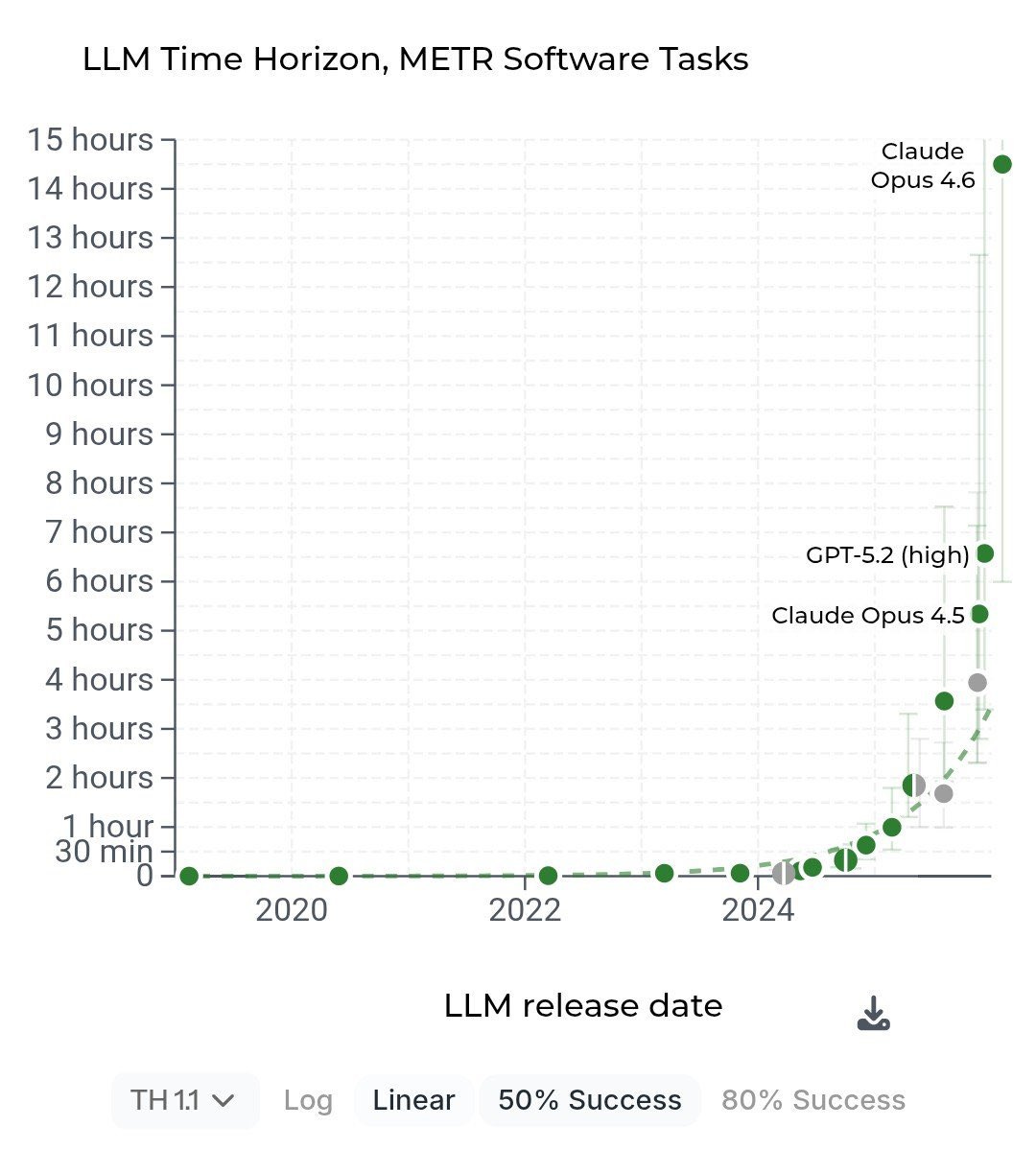
Just a year ago, AI models could handle tasks that would take a human a few minutes. Useful, yes. Revolutionary, not really.
Opus 4.5 shattered that ceiling. It can now replace humans for tasks that would take them up to 14 hours.
Now we’re talking.
If you haven’t used AI in a few months, whatever you last touched is now ancient history.
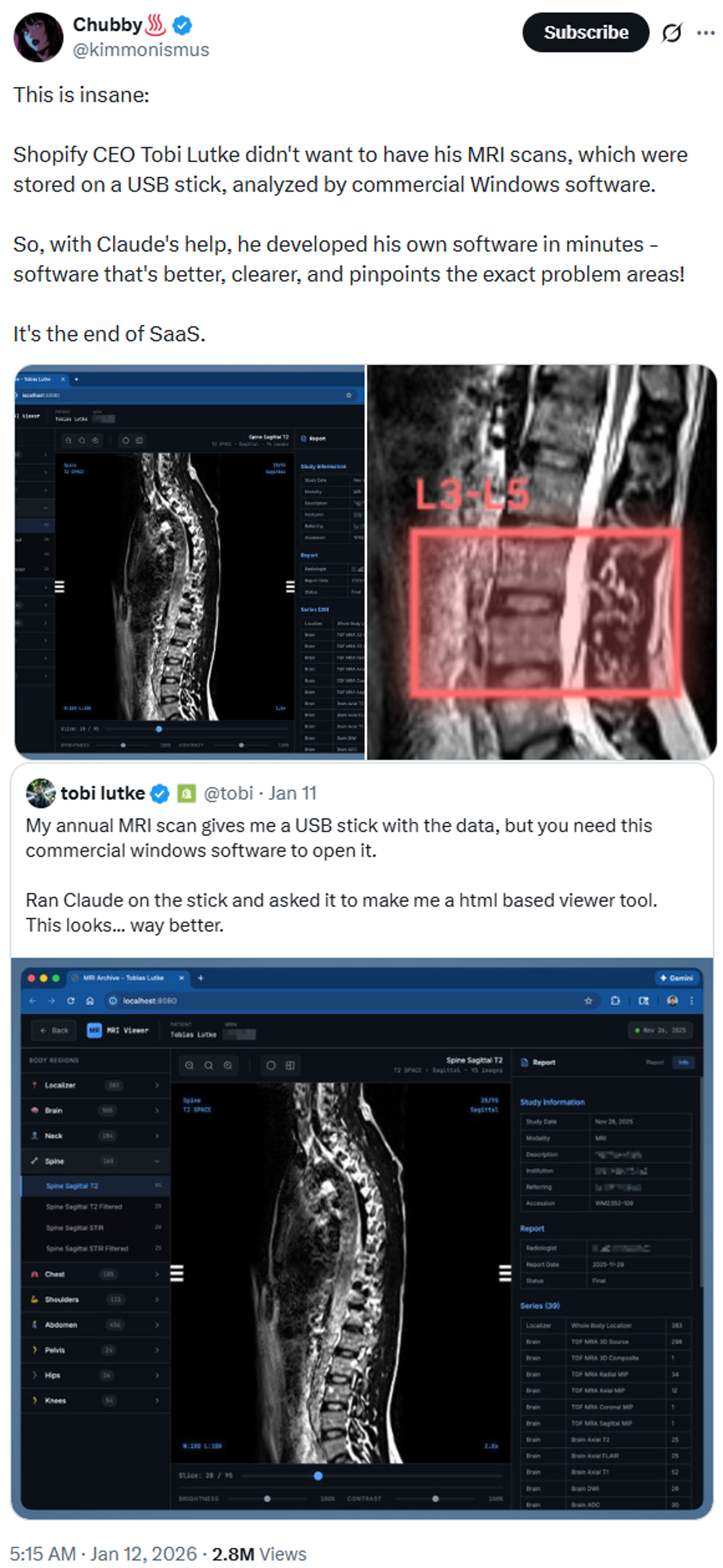
Can’t find software that does exactly what you need? Ask AI to write it.
What used to require a development team and a six-figure budget now requires a prompt and a coffee break.
Last week, Jack Dorsey cut Block from 10,000 employees to just under 6,000. Overnight. But the company behind Square and Cash App is not in trouble. Far from it. Gross profit grew 24% last quarter. Profitability is improving.

Dorsey did not fire 4,000 people because the company is failing. He fired them because he didn’t need that many people anymore. AI made them unnecessary.
“Within the next year, I believe the majority of companies will reach the same conclusion and make similar structural changes. I’d rather get there honestly and on our own terms than be forced into it reactively.”
The stock jumped 24% after hours.
Four thousand people lost their jobs and the market threw a party.
Expect more of that in the coming months.
The SaaSpocalypse
Here is how Wall Street’s favorite business model works. Software-as-a-Service companies build a product once, then sell licenses by the seat. Company X pays $100 per employee per month. The software is generic, the margins are beautiful, and the recurring revenue makes analysts happy.
These companies traded at sky-high multiples of their earnings because the expectation was that those earnings would grow forever.
Then Claude showed up with Opus 4.5.
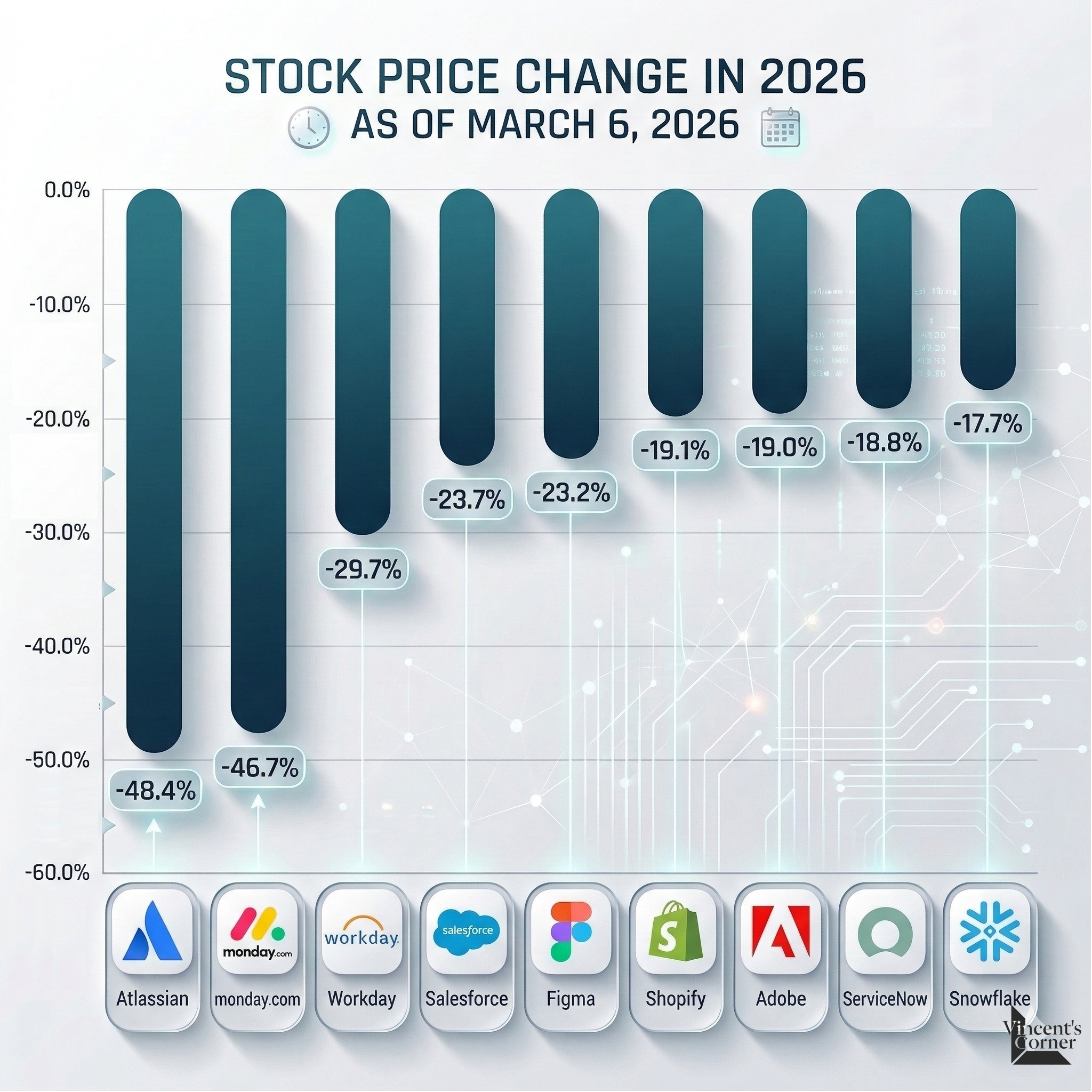
On February 3, 2026, roughly $285 billion in market capitalization evaporated in a single trading day. Goldman Sachs’ basket of U.S. software stocks fell approximately 6%, the worst decline since the April 2025 tariff scares. Fortune described the broader carnage as a trillion-dollar selloff over the week.
Traders called it the SaaSpocalypse. The name stuck.
Why would a company pay millions in annual licenses for generic software, then spend millions more customizing it, when a handful of developers armed with Claude can build a bespoke application that fits their exact needs for a fraction of the cost?
The per-seat licensing model assumed that software was expensive to create. That assumption just died.
The entire SaaS sector is being re-rated. Multiples that were priced for eternal growth are coming back down to earth. Some of these companies will adapt. Many will not.
The ones selling glorified wrappers around capabilities that a general AI model now provides out of the box are in the most trouble.
The Crusade
Claude was the first AI model deployed on the military’s classified networks. It was used in the operation to capture Venezuela’s Nicolás Maduro and in the military operations in Iran. The Department of War (yes, they rebranded the Department of Defense) loved Claude’s capabilities.
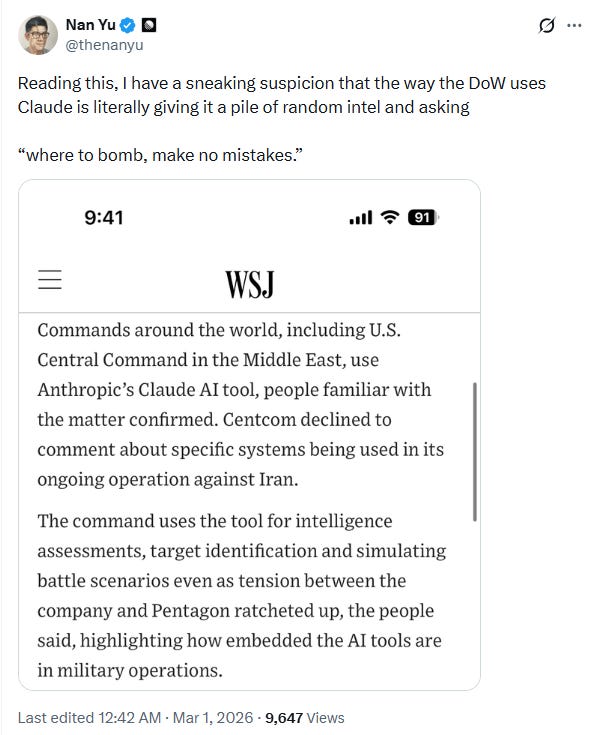
But the Pentagon wanted more. Specifically, according to Anthropic, it wanted the company to remove its guardrails, which Anthropic believed could lead to crossing two if its red lines: mass surveillance of American citizens, and fully autonomous weapons.
Anthropic refused.
CEO Dario Amodei published a statement: “Threats do not change our position: we cannot in good conscience accede to their request.”

The Pentagon’s undersecretary called Amodei a “liar” with a “God complex.” President Trump ordered every federal agency to cease all use of Anthropic’s technology. Secretary of War Pete Hegseth designated Anthropic a “supply chain risk,” a classification normally reserved for companies from adversarial nations like Huawei.
The next day, OpenAI’s Sam Altman stepped in and announced a deal with the Pentagon.

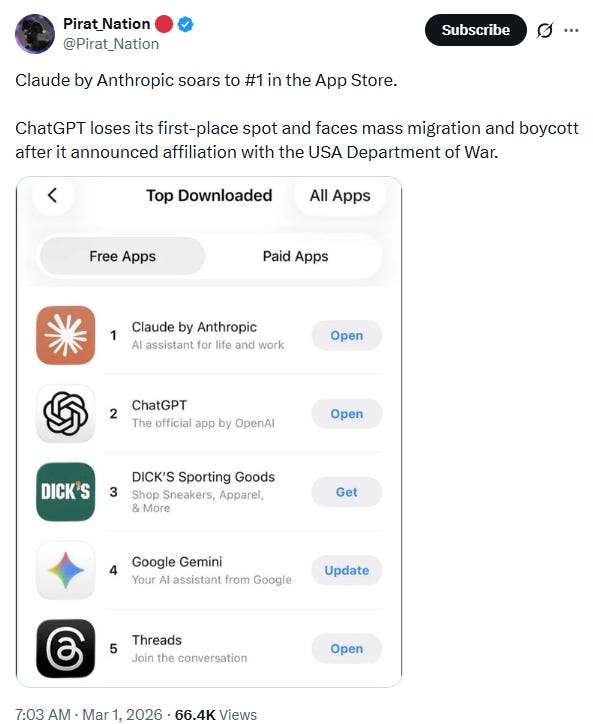
The market’s response was swift and unexpected. Users flocked to Claude.
Anthropic’s app rocketed to the number one spot on the Apple App Store, overtaking ChatGPT. Daily sign-ups exploded. Paying subscribers more than doubled year-to-date.
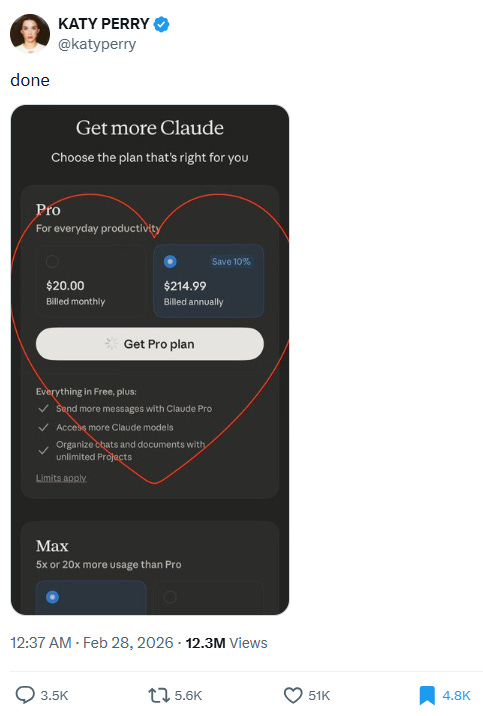
Justin Trudeau’s girlfriend even posted a screenshot of her Claude Pro subscription with a heart superimposed over it.
This might be a Google moment. Remember Yahoo? First mover. Dominant search engine. Best product for years. Then a superior product appeared, and the rest is history.
At the corporate level, Anthropic increased its market share from 10% to close to 70%, in just a year.
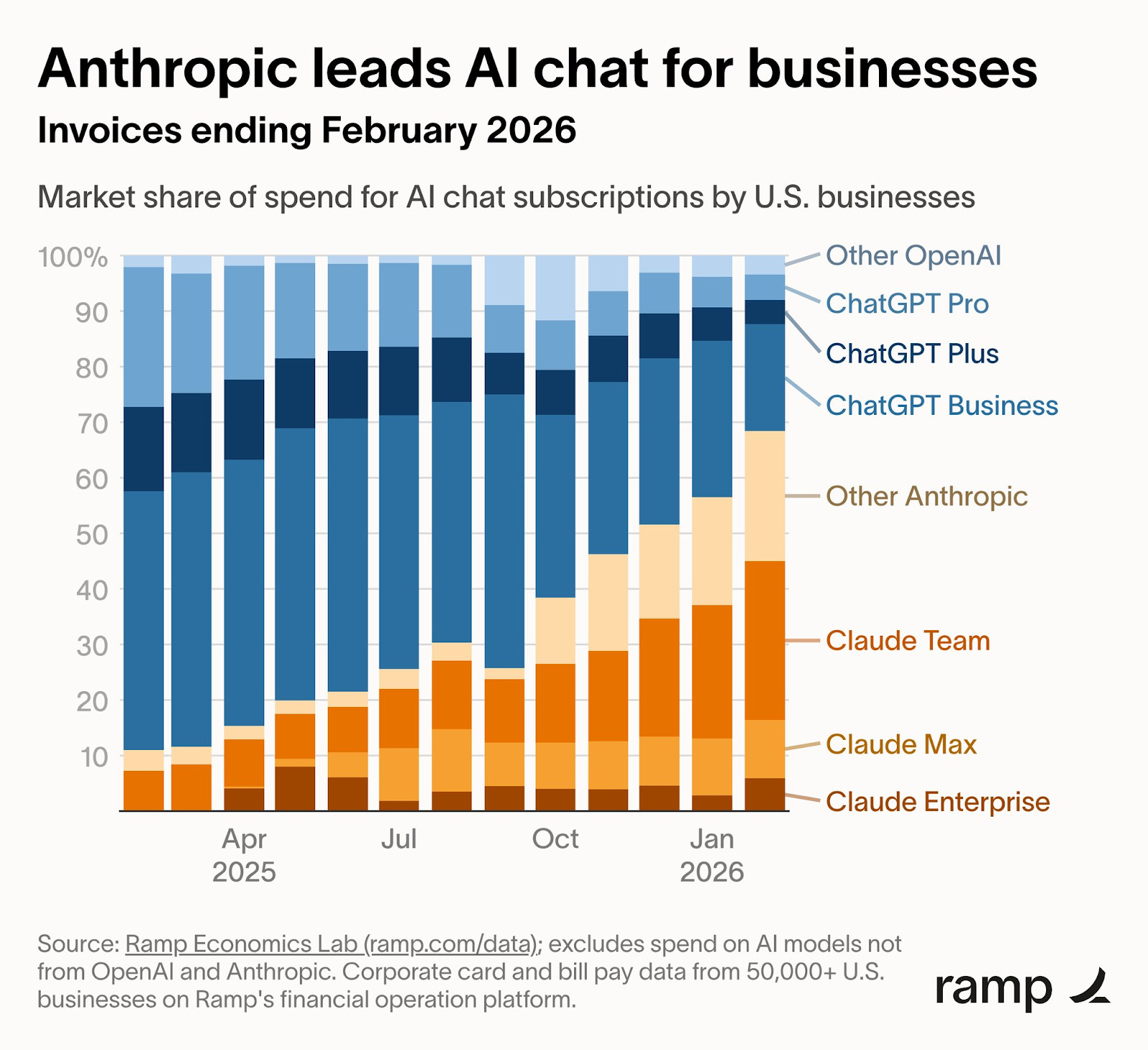
ChatGPT has the name recognition and 900 million weekly users. But Claude has the product, the enterprise market share, and now the moral high ground.
The Almighty works in mysterious ways.

Burning Bushes of Cash
Developing AI models is expensive. Very expensive.
These AI companies are raising and burning money at a pace that makes the dot-com era look like a blip on the radar.
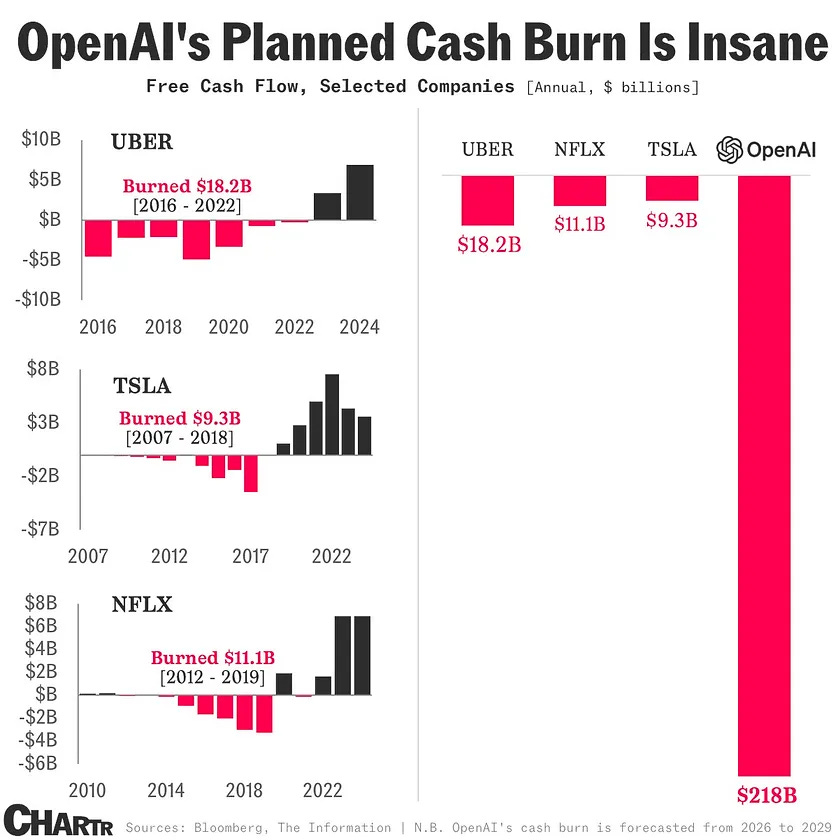
OpenAI alone is projected to burn through $218 billion before becoming profitable. For context, Uber burned $18.2 billion over six years. Tesla burned $9.3 billion over eleven years. Netflix burned $11.1 billion over seven years. OpenAI’s projected burn dwarfs all three combined by a factor of five.
To feed this insatiable appetite, every hyperscaler is ramping capital expenditure.
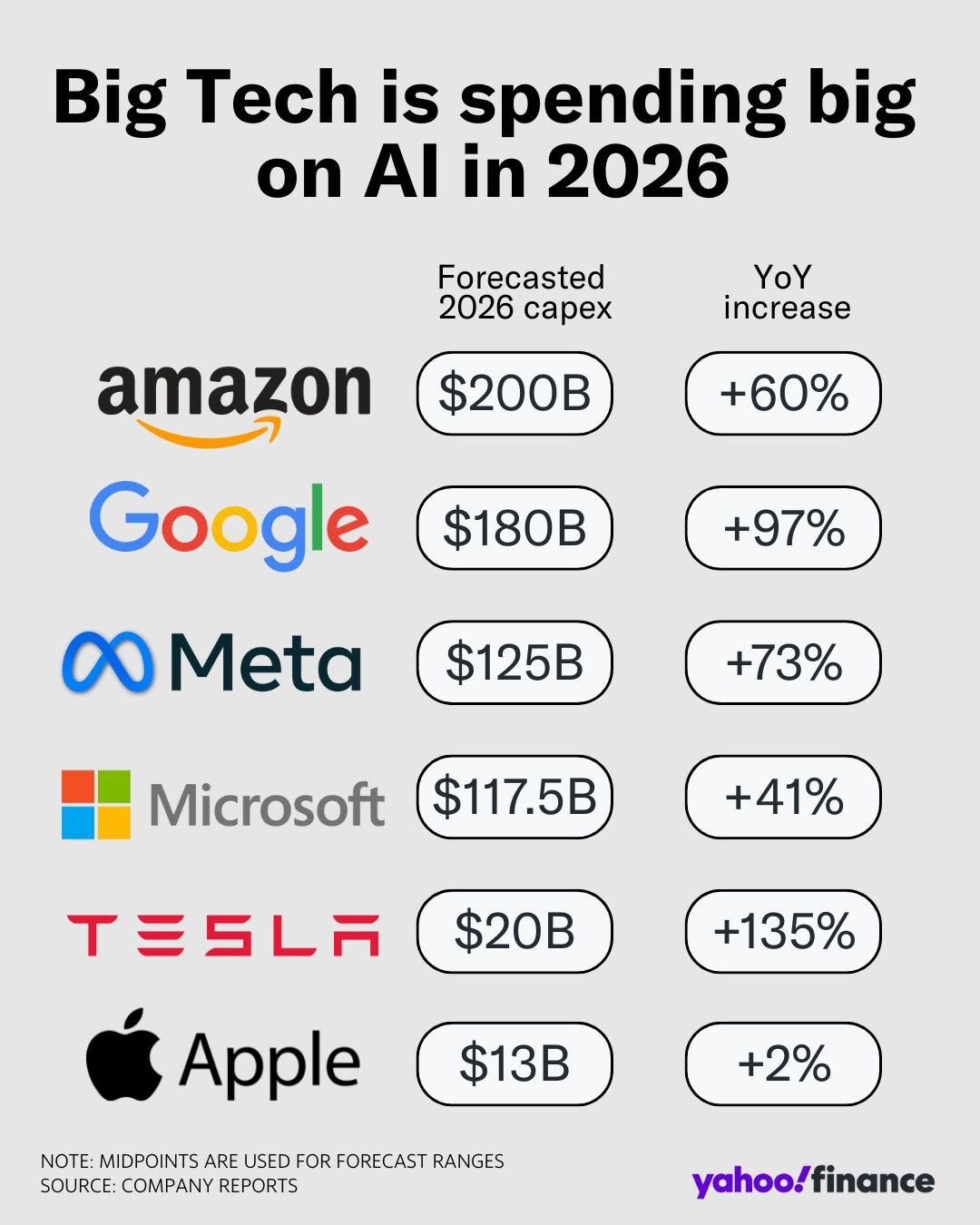
Combined, these five companies plan to spend more than $600 billion on infrastructure this year. That is more than the GDP of countries like the United Arab Emirates, Singapore, or Israel.
And then there is France.
President Emmanuel Macron was recently roasted on X for tweeting that France would invest €30 million in a science spending package that includes AI. The online reaction was not exactly kind. At Alphabet’s planned capex of approximately $180 billion for 2026, Google spends €30 million roughly every 90 minutes. That is about how long it takes a Parisian to finish lunch.

As a Frenchman, I love my country. But as someone who understands exponential curves, this was painful to watch. Macron tried to defend the figure by pointing to the larger €54 billion France 2030 program and €109 billion in private AI pledges. The math still does not add up. Europe is bringing a baguette to a gunfight.
One notable absentee from the AI capex arms race: Apple. While its peers plan to spend $600 billion combined in 2026, Apple’s capital expenditure for the year is a modest $14 billion.
They’re sitting this one out.
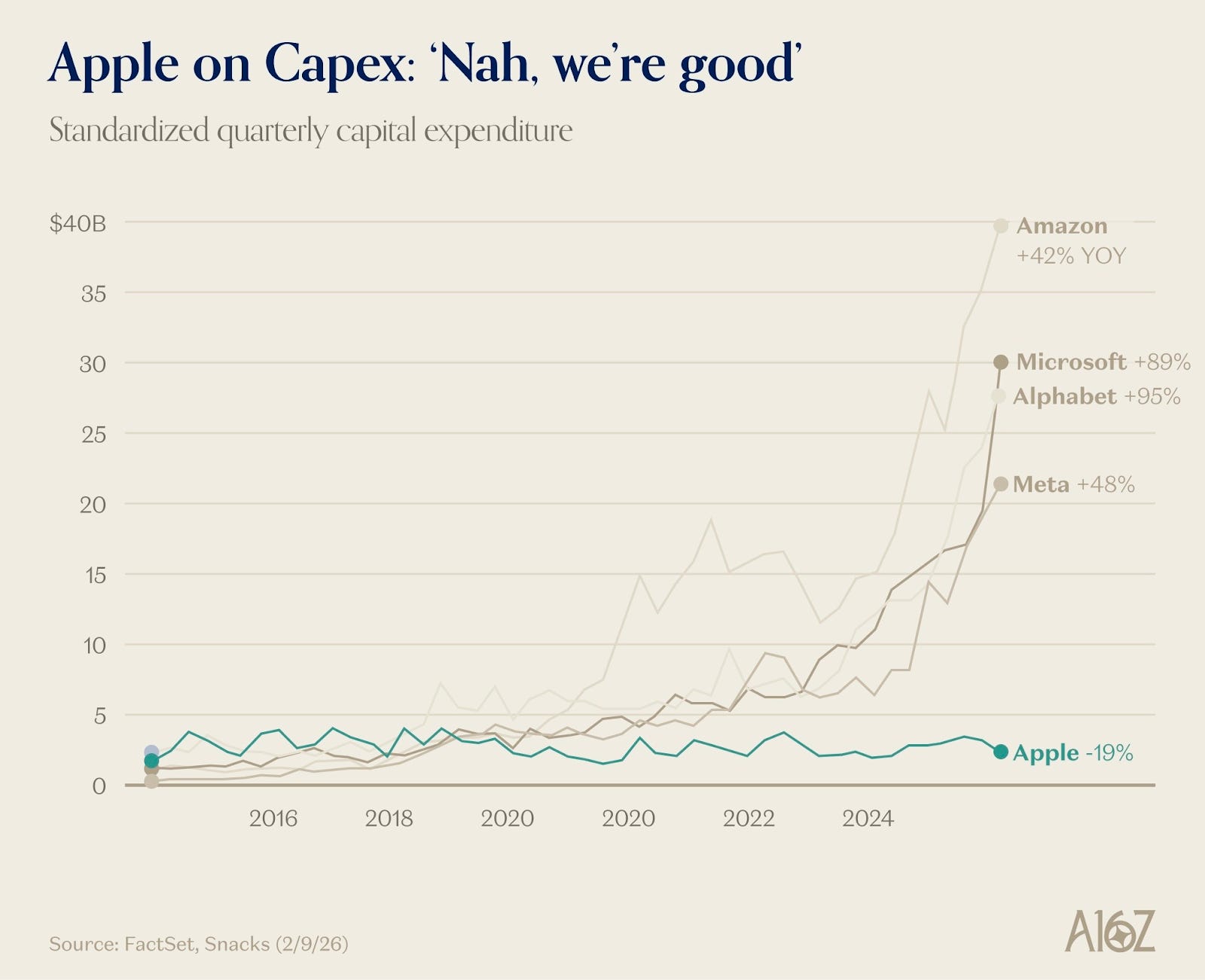
The company has opted to rent computing capacity from partners rather than build its own AI infrastructure, sitting on $130 billion in cash while everyone else hemorrhages money. It recently signed a deal with Google to use their Gemini AI model to power their future version of Siri.
Time will tell who was right, but history suggests that sitting out an arms race rarely ends well. Then again, history also suggests that arms races are expensive for the participants.
Back to the hyperscalers. All these data centers have to be plugged in somewhere.
The AI infrastructure buildout is consuming a rapidly growing share of America’s electricity. Local communities near new data center projects are watching their electricity bills climb as utilities scramble to meet demand from facilities that consume power like small cities. Google alone acknowledged being “supply-constrained” on energy despite planning to nearly double its capex.
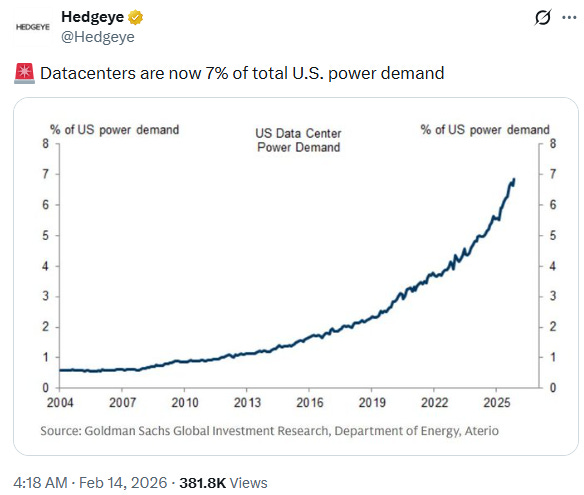
This is why hyperscalers are starting to sign deals to buy or generate their own electricity. Google acquired Intersect Power for $4.75 billion. France is pledging one gigawatt of nuclear power to AI training. Microsoft has signed deals for nuclear energy.
The scramble for power is on.
The backlash against AI and how it worsens affordability for regular people is only beginning. When your electricity bill goes up because a tech company is training a model that might replace you, the political dynamics get complicated fast.
The Sermon
Every month you wait to integrate AI into your workflow, the gap between you and those who use it grows wider. Not linearly. Exponentially.
The person who started using these tools six months ago is not six months ahead of you. They are operating in a different category entirely.
I have written about this before, and I will keep writing about it. I use AI tools every single day. They have not replaced my job, but they have made me dramatically more productive.
Tasks that would have taken hours now take minutes. Research that would have required a team of junior analysts can be done in a conversation with Claude.
Don’t know what to use AI for? Ask AI.
Don’t know how to ask AI? Also ask AI.
You can ask it to write the prompt that will ask you to provide the details it needs to figure out how it can help you.
Read that sentence again.
It sounds circular. It is not.
It is recursive. And recursive thinking is the skill that separates those who will thrive in this economy from those who will be replaced by it.
I therefore see AI as a personality amplifier; it will give more agency to those who already have it, and take more from those who already lack it.
The SaaSpocalypse is just the beginning. The re-rating of human capital comes next. Your skills have a shelf life, and that shelf life just got shorter.
Update your skills. Or update your résumé.
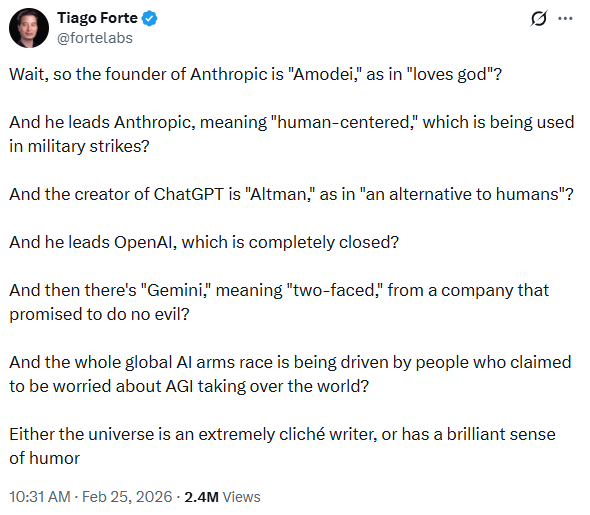
Bonus: God’s Work, The Cast
I don’t know if we live in a simulation. But if we do, we won’t be able to say there weren’t clues out there.
Nothing in this newsletter constitutes financial or investment advice. All content is provided for informational and entertainment purposes only. I’m just a guy with a keyboard, some AI assistants, and opinions about the economy—not your financial advisor. Financial markets are unpredictable, and any investments you make based on what you read here (or anywhere else) are entirely at your own risk. Always do your own research and consider consulting with a qualified financial professional before making significant investment decisions. Past performance of any asset mentioned is not indicative of future results. In short: if you make money based on something I wrote, it’s because you’re smart—if you lose money, that’s definitely not on me.
You don’t discuss DeepSeek. In China the line between (mostly state owned) corporations and the state are blurred in the extreme. Not only will DeepSeek not stand up to the CCP - they will do its bidding. The AI race is global.